

Laser marking on aerospace parts is a critical process that ensures the durability and traceability of components used in aircraft and spacecraft. This technology employs focused laser beams to create permanent marks, such as serial numbers, barcodes, UID marking and logos, directly onto the surface of materials like aluminum, titanium, and composites. The precision of laser marking not only enhances the identification of parts throughout their lifecycle but also minimizes the risk of contamination and damage associated with traditional marking methods. As aerospace regulations demand stringent quality and safety standards, laser marking provides a reliable solution that meets these requirements while offering high efficiency and low operational costs. Control of the heat-affected zone is critical to prevent structural damage when marking a variety of aerospace components. Aerospace marking specifications such as AS478 and Mil-Std-130 are crucial guidelines that ensure the identification and traceability of components used in aviation and space applications.


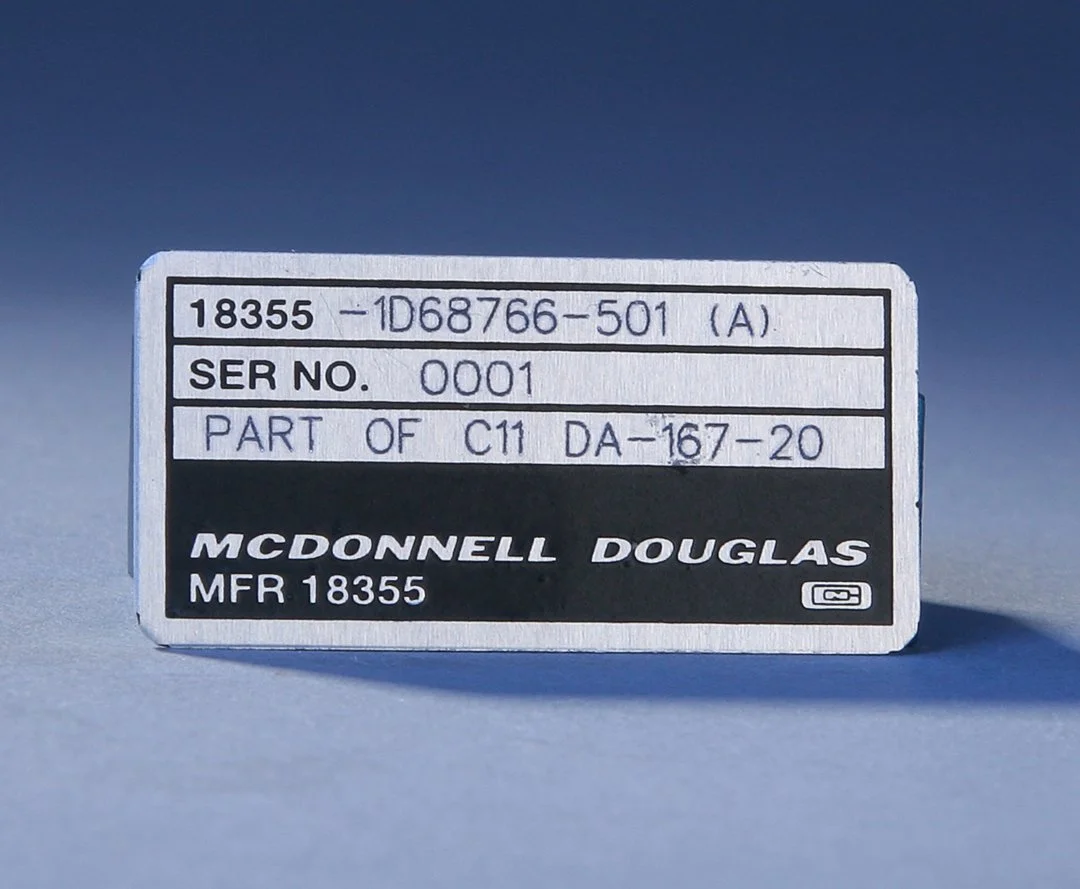

Some of the requirements seen in the aerospace field for their marking and engraving include:
High-quality, precise, and reliable marks
Marks that are readable to both humans and machines
Ability to mark on diverse materials
Marks that are repeatable to ensure uniformity for parts
Being able to trace any parts later deemed defective, to ensure they are replaced or not utilized
Our laser marking services meet the stringent traceability and durability standards required for aerospace components and mission-critical parts.
Aerospace Laser Marking FAQs
1. What is Aerospace Laser Marking?
Aerospace Laser Marking is a precision identification process that uses laser technology to permanently mark aircraft parts with serial numbers, barcodes, UID codes, and compliance details. Because aerospace components must meet strict traceability standards, this method provides a clear, permanent way to label everything from engine components to electronic assemblies. The accuracy of Aerospace Laser Marking ensures that even the smallest parts carry readable, long-lasting identifiers.
2. Why is Aerospace Laser Marking so important in the industry?
The aerospace field depends on exact documentation, and Aerospace Laser Marking plays a central role in ensuring safety and accountability. Markings link each component to its manufacturing history, maintenance records, and certification data—something vital for FAA, DoD, AS9132, and MIL-STD-130 requirements. Without reliable Aerospace Laser Marking, it would be nearly impossible to maintain the level of oversight needed for aircraft performance, inspections, or long-term service monitoring.
3. Is Aerospace Laser Marking safe for sensitive materials?
Yes. One of the advantages of Aerospace Laser Marking is that it doesn’t compromise the structural integrity of sensitive materials. Unlike mechanical marking methods that can cause micro-cracks or surface stress, laser systems apply controlled heat or light to mark surfaces cleanly and precisely. Whether the part is titanium, stainless steel, anodized aluminum, ceramics, or composite materials, Aerospace Laser Marking is engineered to preserve strength and surface quality.
4. How durable are markings made through Aerospace Laser Marking?
Markings made with Aerospace Laser Marking are incredibly durable - built to handle extreme heat, fuel exposure, vibration, and chemical contact. Because the laser alters the surface directly instead of applying ink or adhesive, the mark won't fade, smear, or peel. This long-lasting quality is essential for aircraft parts that may be in service for years or even decades.
5. What information is typically added during Aerospace Laser Marking?
Common data encoded through Aerospace Laser Marking includes:
Serial/batch numbers
Data Matrix, UID, and QR codes
Manufacturer and model information
Engineering specs
Certification or compliance symbols
These markings help maintenance teams and automated systems quickly trace part history and ensure quality control.
6. Can Aerospace Laser Marking be automated?
Absolutely. Many modern production lines integrate automated Aerospace Laser Marking systems with robotics, conveyors, and vision-guided tools. Automation ensures consistent mark depth, placement, and readability—especially important when manufacturers must meet strict aerospace traceability standards. Automated verification systems also scan each mark to confirm that it meets DoD or MIL-STD readability requirements before parts move forward in assembly.